


The term “AI agent” has been stretched so far that it’s close to meaningless. Nearly everything is marketed as an agent now—LLM wrappers, workflow bots, Chrome extensions, scheduling tools. Vendors are agent-washing faster than teams can understand what agents are even meant to do.
Yet beneath the hype, one thing is consistent:
Agents are useful only when matched to the right class of problem.
Most implementation failures come from reaching for agentic architectures either where simple automation is sufficient or where autonomy simply cannot hold up. To avoid both extremes, we need a clearer framework—one grounded in capability fit rather than marketing momentum.
This essay lays out the model I use to evaluate agentic use cases and identify where autonomy truly creates leverage.
What an AI Agent Actually Is
Let’s start by restoring precision to the definition.
When I say “AI agent,” I’m not referring to any system with an LLM behind it, nor to every assistant with a chat interface. An agent is something more specific:
An AI agent is a software entity capable of perceiving its environment, making decisions, and taking action with a degree of autonomy.
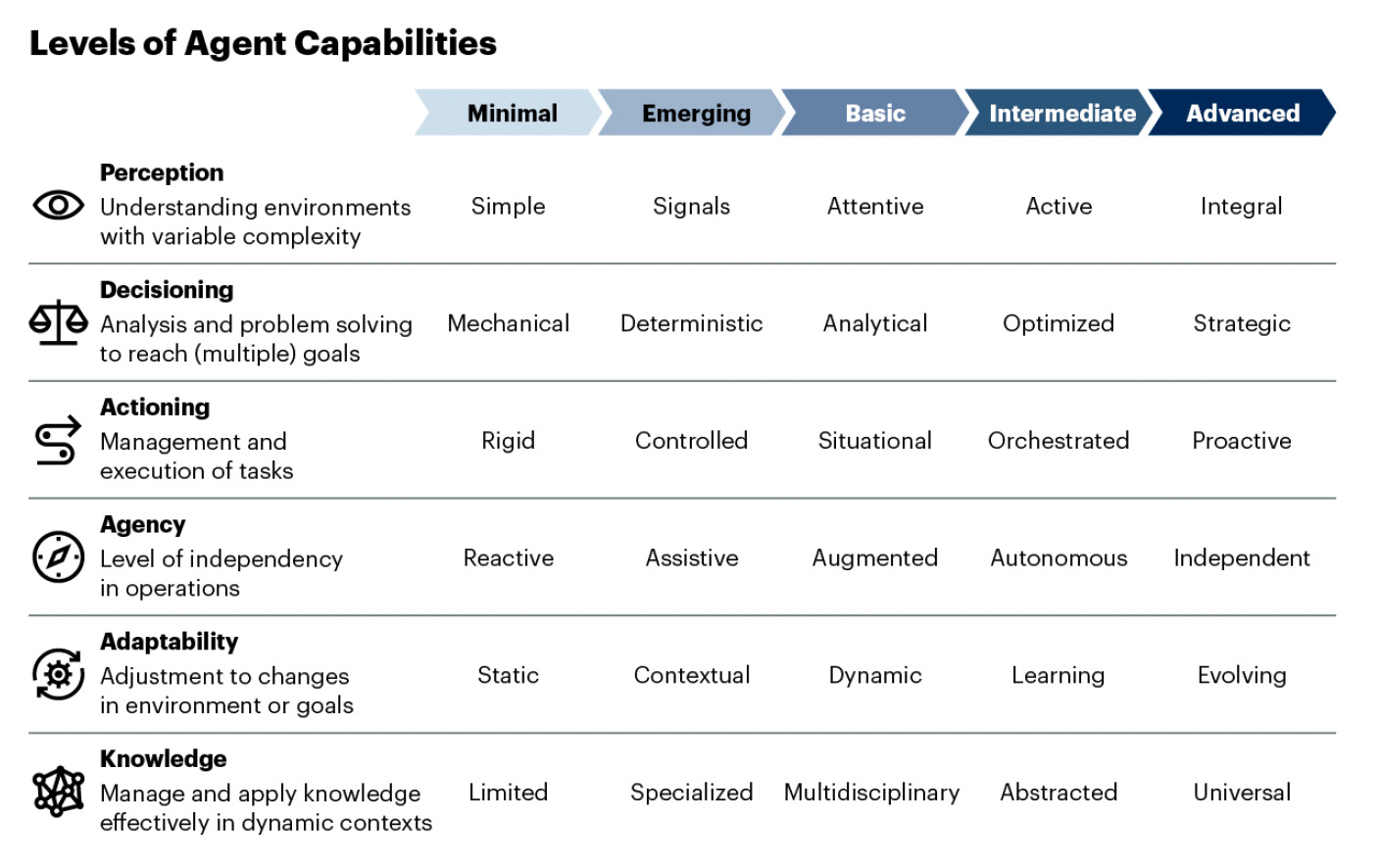
The defining element is independent operation, not tool use or chain-of-thought reasoning. To clarify what this means in practice, I think in terms of six capabilities:
Perception: Quality of environmental understanding
Decisioning: Ability to reason and prioritize
Actioning: Adaptiveness in execution
Agency: Degree of self-initiated operation
Adaptability: Capacity to adjust as conditions shift
Knowledge: Breadth and usefulness of information applied
Most “agents” only show fragments of this list. True agents demonstrate all six at meaningful levels.
With that foundation in place, we can ask a more productive question: when is an agent the right tool for the job?
Where Agents Belong: The Middle of the Complexity Curve
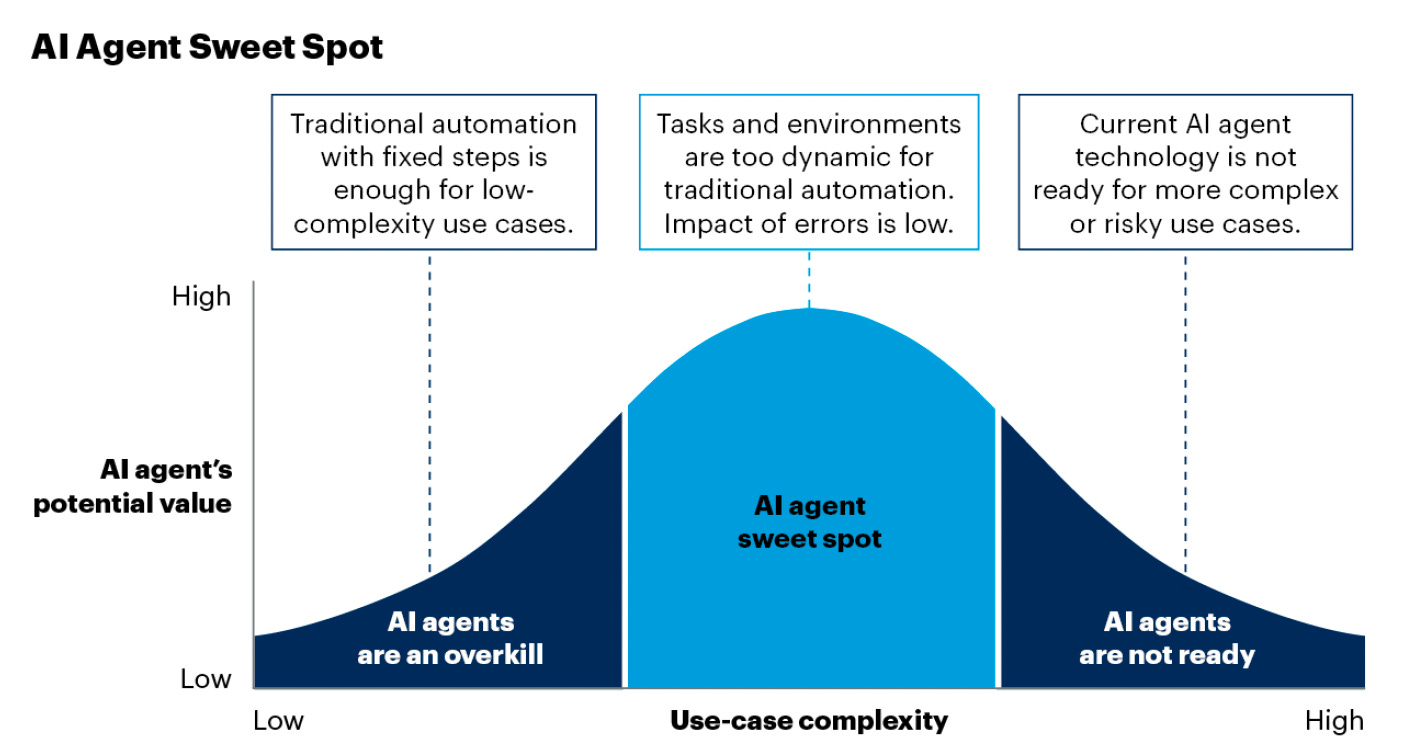
Agents thrive in environments that are too variable for deterministic automation yet not so unpredictable that autonomy becomes risky or brittle. The core insight is simple:
Agents deliver value only in the middle of the complexity curve.
Imagine an inverted-U:
Left side: The task is simple → a script or workflow engine is enough.
Middle: The task is dynamic and context-dependent → an agent makes sense.
Right side: The task is high-risk or unfixed → autonomy becomes unstable.
To evaluate where a use case sits on this curve, I use the same six dimensions that describe agent capabilities.
1. Complexity of the Environment
If the environment is stable and predictable, deterministic automation wins.
If it’s dynamic, multi-variable, or heavily contextual, an agent can add value.
Example:
Booking travel through a single, fixed toolchain doesn’t require autonomy. But coordinating multi-modal transportation across shifting preferences, inventories, and policies benefits from agentic flexibility.
Environmental variability is often the strongest predictor of agentic fit.
2. Complexity of the Goals
Some tasks have a single, unambiguous objective. Others require balancing tradeoffs—cost vs. speed, convenience vs. policy, personalization vs. constraints.
As soon as goals conflict, rule-based systems start breaking down.
Agents excel when the decision surface can’t be flattened into a simple rule set but doesn’t require deep human judgment either.
3. Variability of Execution
A good test: Do the steps change based on context?
If the flow is identical every time, use deterministic automation.
If “what happens next” depends on sensing, interpretation, or real-time conditions, agents help.
Example:
Support-ticket triage varies by customer intent, history, and metadata. Refund issuance does not.
Execution variability creates the conditions for agentic reasoning to matter.
4. Required Autonomy
Autonomy isn’t binary; it ranges from suggestion to supervision to full independence.
Human-in-the-loop: The agent proposes actions; humans finalize them.
Human-on-the-loop: The agent acts; humans review and override as needed.
Fully autonomous: The agent operates without intervention.
Most organizations imagine (3) but are realistically prepared for (1).
And that’s fine—use the smallest amount of autonomy that accomplishes the task.
If a use case only requires (1), a semi-agentic assistant may be more appropriate than a full agent.
5. Dynamics of the Environment
Some environments barely change. Others shift constantly due to external inputs, user behavior, or system constraints.
Agents shine when conditions evolve in ways that deterministic logic struggles to anticipate; they falter when conditions shift so unpredictably that even an adaptive system loses grounding.
Humans remain essential in settings requiring intuition, risk sensitivity, or moral judgment.
6. Breadth of the Domain
Agents gain advantage when tasks span multiple knowledge domains or require synthesizing diverse signals. Narrow domains with fixed rules are better suited to scripted logic.
Troubleshooting field equipment under uncertain conditions? Agentic.
Reconciling invoices? Not agentic.
The Sweet Spot for Agents

If a use case combines:
context variability
multi-goal reasoning
dynamic inputs
non-deterministic execution
manageable risk
cross-domain knowledge
…it likely falls in the agent sweet spot.
But stray too far toward either extreme—too simple or too complex—and agents either add unnecessary overhead or fail outright.
When Not to Use Agents
Despite the hype, there are several clear disqualifiers.
1. Real-Time or Safety-Critical Requirements
Agents that rely on heavyweight reasoning or multistep planning struggle with predictable latency. Industrial control, autonomous navigation, and high-frequency trading all demand deterministic behavior.
2. Mandatory Explainability
Opaque models break down in regulated or sensitive domains, including HR screening, medical triage, and compliance workflows.
When stakeholders require transparent reasoning, use causal models, rules, or structured optimization—not agentic autonomy.
3. Misaligned Cost Structure
LLM-powered agents introduce ongoing costs: tokens, tool calls, compute scaling, observability, guardrails. If the value per action is low, the economics rarely hold.
4. Tasks Requiring Human Qualities
Agents don’t replicate empathy, intuition, or nuanced judgment. In these cases, agents should augment humans, not replace them.
5. Organizational Unreadiness
Without strong data foundations, governance, monitoring, and change-management support, agentic deployments stall. Autonomy is an operational commitment, not a feature drop.
When a Single Agent Isn’t Enough: Multiagent Systems
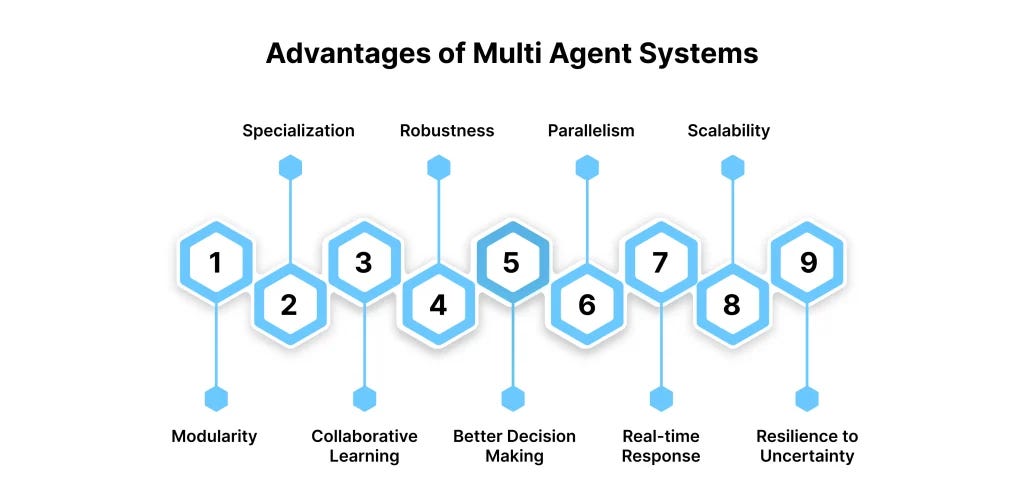
Some problems exceed the capabilities of any one agent. Multiagent systems (MAS) become useful when:
specialized agents outperform generalists
redundancy improves robustness
tasks require negotiation or distributed reasoning
workloads exceed a single agent’s cognitive bandwidth
This is where enterprise AI is heading: ecosystems of specialized agents coordinated through explicit protocols, not monolithic “super agents.”
Examples to Ground the Framework
Strong Agentic Fit: Travel & Logistics Automation
Dynamic conditions, diverse constraints, and shifting inventories make autonomy beneficial.
Weak Fit: Safety-Critical Robotics
Latency and determinism beat flexibility every time.
Sweet Spot: Knowledge Workflows
Agents that navigate documents, tools, and reasoning outperform static RAG pipelines.
Hybrid Cloud–Edge Models
Edge agents handle perception and real-time action; cloud agents coordinate planning and refinement. This distributed pattern will define many next-generation systems.
The Coming Layer of Autonomy
Agents won’t replace every interface or every workflow. But they will become the connective layer where digital systems must navigate uncertainty, adapt to shifting conditions, and operate beyond rigid scripts.
The organizations that benefit most won’t be the ones that deploy agents everywhere—they’ll be the ones that deploy them intentionally, where autonomy compounds instead of complicates.
The real shift isn’t the rise of agentic AI.
It’s the discipline to know where autonomy creates value—and where it erodes it.